what are you looking for?

Good lighting plays an important role in making parks more accessible and comfortable after sunset. It helps visitors navigate pathways, locate entrances, use recreational areas, and move through public spaces with better visibility. However, installing conventional electrical lighting across a large park can involve extensive wiring, trenching, and connection work, particularly in areas far from existing power infrastructure. Solar powered lighting offers an alternative by generating and storing energy on site, giving park planners more flexibility when deciding where lighting is needed.
One of the main advantages of solar lighting is its flexible installation. Since each fixture can generate and store its own energy, it may be installed in locations where extending electrical cables would be difficult or costly. This is especially useful for walking trails, garden paths, open lawns, picnic areas, and entrances. Properly positioned solar pathway lights can help define walking routes and improve visibility along frequently used paths. For larger parks, solar lighting can also reduce the amount of electrical infrastructure required, although installation still needs suitable foundations, secure mounting, and enough exposure to sunlight.
Solar powered lighting can also help parks manage energy consumption. During daylight hours, photovoltaic panels convert sunlight into electricity, which is stored in rechargeable batteries for use after dark. Efficient LED technology allows many modern solar lights to provide useful illumination while relying on stored solar energy rather than continuous grid electricity. This can reduce dependence on purchased electricity and may lower operating costs over time. However, the actual savings depend on the initial equipment cost, sunlight availability, battery replacement, maintenance requirements, and the amount of lighting needed across the park.
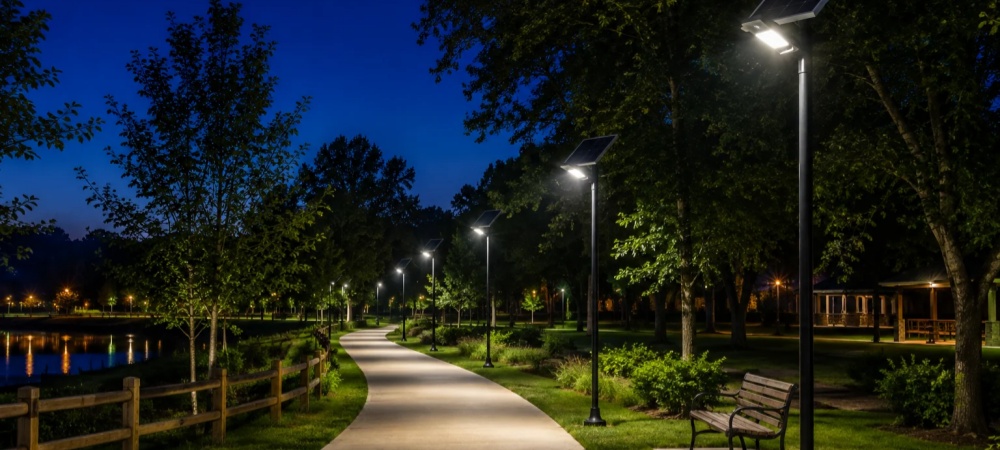
Another benefit is the flexibility to design lighting around different park activities. Main entrances and parking areas may require stronger illumination, while natural walking trails and landscaped spaces often benefit from more controlled, lower-level lighting. Motion sensors, adjustable brightness, and programmed operating schedules can help match light output to usage patterns and available battery capacity. Solar LED street lights may be suitable for access roads, larger pathways, and other areas requiring broader illumination, provided their output and operating time meet the project's requirements. Careful fixture placement and suitable beam angles are also important to reduce glare and unnecessary light spill, particularly near trees, wildlife habitats, and neighboring properties.
Despite these advantages, solar lighting needs to be planned according to local conditions. Trees, buildings, and other obstacles can limit sunlight exposure, while cloudy weather and shorter winter days may reduce the energy available for nighttime operation. Park managers should consider solar panel capacity, battery storage, expected operating hours, light distribution, weather resistance, and maintenance access when selecting equipment. Panels may need periodic cleaning, and batteries will eventually require replacement. For parks with demanding lighting requirements or heavily shaded locations, a hybrid system or conventional electrical lighting may be a more practical solution.
Solar powered lighting provides parks with a flexible way to improve nighttime visibility while reducing reliance on grid electricity in suitable locations. Its greatest value comes from thoughtful planning: placing fixtures where they can receive sufficient sunlight, matching brightness to actual activities, and considering long-term maintenance from the beginning. When these factors are properly addressed, solar lighting can support more accessible, energy-conscious, and well-designed public spaces without requiring extensive electrical infrastructure throughout the park.




Xiamen SLD Technology Co., Ltd
 Chengyi North Street, Software Park 3, Jimei District, Xiamen Fujian, China
 +86 188 5929 8629
 sales@solarlightsdo.com
 Blog | Sitemap | XML | Privacy Policy